When should a newspaper stop printing? Most advice says “it depends.” We think there’s a clearer answer: stop when your paid digital subscriptions can carry the paper. The best reason to end print is that something better has taken its place, and you can measure whether that has happened yet.
PaywallProject has helped local publishers sell digital subscriptions since 2016, most of them small independent newspapers. This guide covers the three numbers to check before you stop the press, what to do about public notices, and one change every print publisher should make to their website now, whether or not they ever stop printing.
The real reason to stop printing: digital subscriptions are ready to take over
Publishers usually treat this as a cost decision. Paper, press time, postage, and delivery cost more every year while fewer people want the result. That’s true, but cost alone is a weak reason to act. Cutting print with nothing to replace it only leaves you with a smaller business.
Print and digital are two ways of selling the same reporting. Once more readers are paying for it online than on paper, print stops being the business and becomes an expensive way to reach a shrinking share of your customers. From then on, every hour spent on layout, press deadlines, and delivery routes is an hour taken from the product that’s growing.
Three signs it’s time to stop printing
1. Paid digital subscriptions are outpacing print
Compare new subscribers, not totals. Your print list may still be larger because it took decades to build. Look at the last twelve months instead. How many new paid digital subscribers signed up, and how many new print subscribers? How many of each didn’t renew?
If digital adds subscribers every month and the print count only goes down, your readers have already told you where they’re headed. Then compare what each one is worth after you fulfill it. A digital subscription costs almost nothing to deliver. A print subscription carries printing and postage with every issue.
2. Print advertising is declining, and can be replaced online
For a long time, advertising was the reason to keep printing. If your print ad revenue has dropped year after year, ask what your remaining advertisers are buying. They want to reach local people, and paper is only one way to do that.
Newsletter sponsorships and banner ads can reach the same people. A newsletter that lands in a few thousand local inboxes every week is an easy sell to the hardware store, the car dealer, and the bank that buy your quarter pages today. You can also show them opens and clicks, which print never could.
You won’t move every print ad dollar online, and you don’t have to, because the printing bill goes away too. What matters is ad revenue after costs, and that’s a much lower bar to clear.
3. Public notices don’t cover the gap
Public notices keep more local papers in print than anything else. Nearly every state requires legal notices to run in a qualified newspaper; most statutes still mean a printed one, and the paper collects a state-set fee for each notice.
The question to ask is whether that money is enough. Add your notice revenue to your remaining print ad revenue, then subtract everything print costs you: printing, postage, delivery, and the staff time that goes into layout. If what’s left doesn’t support the newsroom, public notices are only slowing the decline. That income also rests on a statute your legislature can rewrite, and bills to move notices onto government websites come up in statehouses every year.
If notices do clear that bar, protect them. Losing your qualification is hard to undo, since many states require a year of continuous publication before a paper qualifies. Read your statute and call your press association before you change anything. Ask what the minimum is for frequency, page count, and circulation. Some papers keep a small, low-cost print edition that satisfies the law and run everything else digital-first.
If all three are true, why keep printing?
Digital subscriptions are growing faster than print. Print ads are shrinking, and the advertisers can be reached online. Public notices don’t make up the difference. When all three hold, the part of your business that works is paying for the part that doesn’t.
We recently watched a legacy weekly close. It had a solid website and a growing base of digital subscribers, enough to support a leaner, digital-only newsroom. Print losses used up the cash first. Would it have survived if it had stopped printing two years earlier? Probably. Papers in this position rarely fail because they went digital too soon. They fail because they waited until the money for the transition was gone.
There are good reasons to keep printing. Print ads may still pay for the press run with room to spare. Notices may be profitable after print costs. Or a loyal group of readers may be willing to pay what paper really costs. In that last case, charge them for it. One niche magazine brought print back as print on demand at several times its old price. It prints far fewer copies, and print now makes money.
At the very least, take print off your online checkout
Even if you plan to continue printing for now, stop selling print on your website. Your pricing page and checkout should behave as if the print edition doesn’t exist.
- Online visitors are digital readers already. Someone at your checkout found you on a screen. Offering them paper steers a new customer into the product you’re winding down.
- Every extra plan costs you sales. Print, digital, print plus digital, in-county, out-of-county: that’s five decisions where there should be one or two. Shorter pricing pages finish more checkouts.
- Each new print subscription is a commitment. You’ve promised a year of printing and mailing to one more reader, and you’ve added one more person to move later.
- It tells readers what the product is. When the website sells one thing, the digital subscription becomes the subscription.
Print doesn’t disappear. Current subscribers renew by mail or phone the way they always have, and anyone who wants the paper can call the office or fill out the form printed in it. Look at how the largest papers handle this. Visit the New York Times subscription page and the offer in front of you is digital. Home delivery still exists, but you have to go looking for it.
How to move from print to paid digital subscriptions: 6 steps
Step 1: Sell only digital online
Do this today. It costs nothing, and it starts shifting your subscriber mix before you’ve made any decision about the press.
Step 2: Get every print subscriber logged in
Include digital access with every print subscription. Collect an email address at each renewal, activate the account, and show the reader how to log in. The print subscriber who has never logged in is the one you lose on the day you stop printing.
Step 3: Build your list with a free registration wall
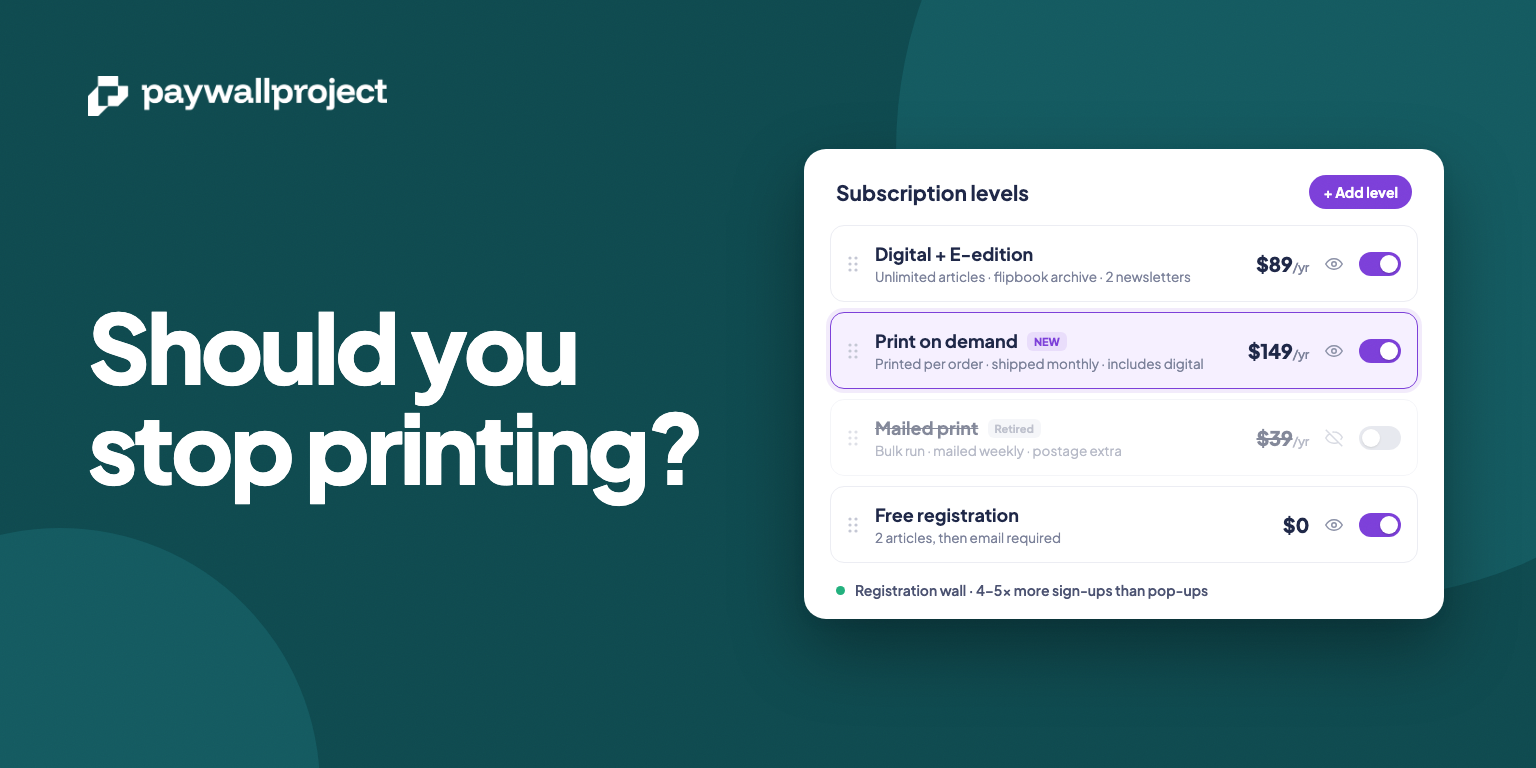
Ask readers for an email address after a free article or two, in exchange for continued access. A registration wall collects far more addresses than a sidebar sign-up form. Those readers are also logged in, so you can see who reads the most and send them a subscription offer.
Step 4: Move advertisers into the newsletter and onto the site
Start selling newsletter sponsorships and banner ads while print is still running, packaged with the print ad. By the time print ends, your advertisers will already be used to buying digital from you, and the bigger list from step 3 gives you more to sell.
Step 5: Keep the e-edition
Some readers love the laid-out page. Give them a replica e-edition and include it in the digital subscription. It works well on a desktop or tablet and poorly on a phone, so treat it as a perk and keep the website and newsletter as the main product.
Step 6: Set a date and tell readers why
Explain the change in the paper, by email, and anywhere else you reach readers. Tell them why you’re doing it, how it will work, and what they get. Readers support a paper that asks for their help plainly. They cancel when the change arrives without warning.
FAQ: Stopping print and going digital
When should a newspaper stop printing?
When paid digital subscriptions are growing faster than print subscriptions, print advertising is declining and can be replaced with newsletter and banner ads, and public notice revenue doesn’t cover the cost of printing. If all three are true, print is costing more than it earns.
Should I sell print subscriptions on my website?
No. Offer only digital subscriptions at online checkout, and take print orders by phone, by mail, or through a form in the paper. Online visitors are already reading on a screen, and fewer plan choices lead to more completed sign-ups.
What happens to public notices if I stop printing?
In most states you would lose your status as a qualified newspaper, and regaining it often takes a year of continuous publication. Check your state’s statute and talk to your press association first. If notices are profitable after print costs, consider a minimal print edition that meets the legal requirement.
Will I lose subscribers if I stop printing?
Some, yes. You’ll lose fewer if every print subscriber already has a digital account and an email address on file before the last issue, and if you explain the change well ahead of time.
The bottom line
- Let digital subscriptions make the decision. When they’re outpacing print, print is no longer the business.
- Replace print ads with newsletter sponsorships and banner ads. You need less ad revenue once the printing bill is gone.
- Do the math on public notices. Keep printing for them only if they pay for it.
- Take print off your online checkout now, whatever you decide about the press.
Want help running these numbers for your paper? Book a call with PaywallProject. We set up the paywall, registration wall, newsletters, and e-edition for you, so the digital side is ready before print goes away.