Learn how to design a subscription funnel that meets reader expectations, nurtures upgrades naturally, and maximizes revenue—plus discover the counterintuitive strategy one publisher used to double subscription prices with a simple email asking readers to “reply yes.”
ESPN taught me an important lesson about subscription pricing—by doing everything wrong.
I was watching the US Open tennis tournament through my Disney+ bundle, which includes ESPN premium access. Everything worked perfectly through the early rounds. Then the quarterfinals arrived, and suddenly I couldn’t stream the match I wanted to watch.
Twenty minutes of frustration later, I discovered the problem: I needed to upgrade my plan to watch the finals. ESPN had let me watch the tournament for a week, built my engagement and expectations, then blocked access at the most crucial moment—with no warning, no nurturing, and no clear upgrade path.
When I finally navigated to Disney+ to upgrade, I faced 12-18 different subscription options with no clear guidance on which one I needed.
I paid the $30/month upgrade fee out of sheer frustration. Then immediately after the tournament ended, I downgraded back to my original plan.
This is a masterclass in how NOT to handle subscription pricing and upgrades. And unfortunately, many publishers make similar mistakes.
The Three Cardinal Sins of Subscription Pricing
Before we get to what works, let’s identify what doesn’t—using real examples from publishers making these exact mistakes.
Sin #1: Complexity That Confuses
One large metro daily news publisher offers:
- Weekly subscription at $2.99/week
- Monthly subscription at $9.99/month
- Day passes at $0.99 each
- No annual plan (despite strong demand for one based on legacy subscribers)
Think of subscriptions like driving a car. All the controls should be exactly where you expect them: steering wheel here, turn signal there, brake pedal in the same spot as every other car.
What’s the EV industry doing? Moving controls to touchscreens. And everybody hates it.
The same principle applies to subscription pricing. Readers expect:
- Monthly plans (the “try it out” option)
- Annual plans (the “I’m committed” option with a discount)
- Full access to everything with either plan
When you deviate from this standard by adding weekly plans, day passes, and multiple tiers with unclear differences, you create friction that costs you conversions.
The data proves it: For this publisher, the monthly plan is their top seller, followed closely by legacy annual subscriptions they’re not even actively selling anymore. The weekly plan captures about 60% of monthly volume, and day passes languish in the teens.
Simplicity wins. Always.
Sin #2: Blown Expectations
The ESPN experience illustrates this perfectly. I expected to watch the entire US Open tournament because I’d been watching it all week. ESPN set that expectation by allowing access, then violated it at the worst possible moment.
Publishers make similar mistakes when they:
- Allow free access to some content, then surprise readers with paywalls on “premium” content without clear delineation
- Change subscription terms or access without clear communication
- Offer trial periods that auto-convert to paid without adequate warning
- Block content unexpectedly after readers have been freely accessing it
When you violate expectations, you create resentment instead of conversions. Readers remember being tricked far longer than they remember good experiences.
Sin #3: No Clear Upgrade Path
ESPN didn’t nurture me toward the upgrade. They didn’t tell me when I signed up: “Hey, if you want to watch the majors and grand slams, you’ll need this higher tier.”
They didn’t send me an email before the quarterfinals: “Upgrade now to ensure uninterrupted access to the finals.”
They just blocked me and left me to figure out what went wrong.
Many publishers similarly fail to create clear upgrade paths from free registration → monthly subscription → annual subscription → donor/supporter tiers.
Without intentional nurturing, readers never move up your value ladder.
The Proper Subscription Nurture Path
Now let’s examine what actually works—a clear, logical progression that meets reader expectations and naturally encourages upgrades over time.
The Four-Tier Framework
A properly designed subscription funnel includes these tiers:
Tier 1: Free Registration
- Reader provides email address
- Gets added to newsletter list automatically
- Receives 1-2 free articles per month after initial registration
- Experiences upgrade messaging regularly but non-intrusively
This tier serves two purposes: it captures email addresses for your owned audience, and it creates a conversion funnel for paid subscriptions.
Tier 2: Monthly Subscription
- Slightly more volatile readers who want to “try it out”
- Easy entry point with low commitment
- Full access to all content
- Higher churn risk but important for conversions
The monthly plan attracts readers who aren’t quite ready to commit annually but want regular access. Many will stay on monthly indefinitely, while others will naturally upgrade to annual as their engagement deepens.
Tier 3: Annual Subscription
- Committed readers who save money by paying annually
- Lower churn rate—they’re locked in for a year
- Signal of deeper engagement with your publication
- Should be your “most popular” option (as labeled on pricing pages)
The annual plan represents a significant milestone in reader commitment. Someone paying for a full year upfront is saying: “I value this enough to commit long-term.”
This is where many publishers stop. But you’re leaving money on the table if you don’t offer a fourth tier.
Tier 4: Premium Supporter Options
This tier varies by publication but typically includes one or more of:
- Donor/Supporter tier: Higher price point for readers who want to financially support your mission beyond basic subscription costs
- Gift subscriptions: Allow subscribers to purchase subscriptions for others (should represent ~20% of total subscriptions based on print publishing data)
- Corporate/Group access: Bulk subscriptions for businesses, schools, libraries, or organizations
Every publication should offer at least one of these premium options. Your most engaged readers WANT ways to support you beyond basic subscription fees—you just need to make it easy for them to do so.
Example: Daily Memphian’s Approach
The Daily Memphian offers a solid example of this framework in action:
- Free registration captures emails
- Monthly and annual subscription options clearly presented
- Annual plan labeled “Most Popular” (social proof)
- Additional options for donations, gift subscriptions, and group/corporate access
They also include a specific page for college and university access with a contact form—recognizing that institutional subscriptions require custom pricing and conversation.
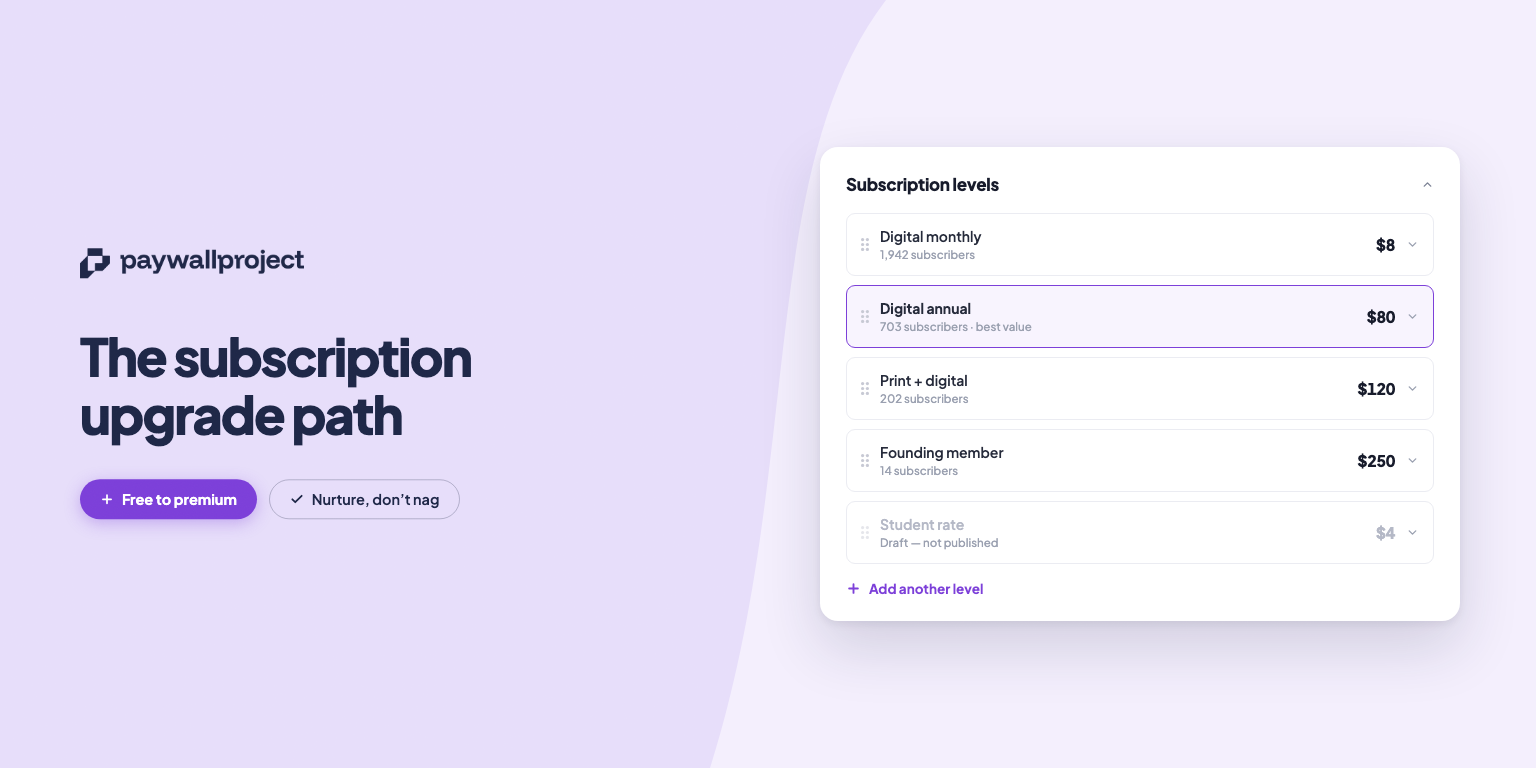
This structure provides a clear path: Free → Monthly → Annual → Supporter/Donor → Gift/Corporate
Each step represents deepening engagement and increased lifetime value.
What NOT to Do: The “Premium Plus” Trap
Some publishers try to create tiered content access:
- “Basic” subscription gets you some content
- “Premium” subscription gets you everything
- “Premium Plus” gets you even more special content
This almost never works well for news publishers.
The lines are too blurry. Readers pay for a subscription expecting full access, then discover they need to pay more for certain articles. This creates the exact expectation violation we discussed with ESPN.
Unless you have a very specific reason for tiered content access (like specialized newsletters or exclusive event access that’s clearly branded as premium from the start), avoid this approach.
Simple is better: Pay, get access to everything. Want to support more? Become a donor or gift subscriptions to others.
The Gift Subscription Opportunity
Gift subscriptions are vastly underutilized by digital publishers, yet print publishing data shows they should represent approximately 20% of your total paid subscriptions.
Why gift subscriptions matter:
Revenue without acquisition costs: Your existing subscribers do the selling for you. They’re buying subscriptions for friends, family, or colleagues—people who are likely already aware of your publication.
Higher conversion rates: Recipients of gift subscriptions convert to paying subscribers at much higher rates than cold traffic once their gift period expires.
Seasonal spikes: Gift subscriptions surge around holidays, birthdays, and graduation seasons, creating predictable revenue bumps.
Community building: Gift subscriptions strengthen your local presence as readers actively recommend and share your journalism.
Yet when I talk to publishers about gift subscriptions, most respond: “Yeah, that’s a good idea. We should do that.”
They should. If print publishers consistently achieved 20% gift subscription rates, digital publishers should aim for at least 10-15%.
Make gift subscriptions prominent on your pricing page, easy to purchase, and actively promote them during holiday seasons.
The Nonprofit Friction Strategy
For nonprofit publishers who can’t technically “sell” subscriptions but need to generate revenue, there’s a clever approach that removes friction for paying members while maintaining free access:
The 24-Hour Free Access Window
- Reader gets one free article without registration
- Second article requires free registration with email
- Registration grants 24 hours of full access
- After 24 hours, access expires
- Reader encounters a prompt: “Become a member for unlimited access, or renew free access for another 24 hours”
- The renewal option is small, less prominent, slightly buried
This creates friction without technically blocking free access. Content remains free, but accessing it repeatedly becomes annoying enough that engaged readers will pay to remove the hassle.
It’s similar to YouTube’s model: You can watch with ads (free but annoying), or pay for YouTube Premium (ad-free). You’re not paying for access to content—you’re paying to remove friction.
This approach works particularly well for nonprofits because:
- It maintains truly free access (meeting nonprofit transparency expectations)
- It creates a clear value proposition for membership: convenience and friction removal
- It naturally segments your audience between casual readers (who’ll tolerate the hassle) and engaged readers (who’ll pay for convenience)
- It doesn’t require complex metering or content categorization
Publishers using this approach report strong conversion rates from free to paid, with the friction model clearly communicating value without making readers feel blocked or tricked.
The “Reply Yes” Upgrade Strategy That Doubled Revenue
Here’s a counterintuitive approach one local publisher used to dramatically increase revenue from existing subscribers.
The publisher sent an email to their subscriber base explaining:
- They’d invested in an events calendar
- They’d hired additional reporters
- They were expanding community coverage
- They needed subscriber support to continue this investment
Then they made a simple ask: Would you consider upgrading from $10-12/month to $20/month?
To accept, subscribers just needed to reply “YES” to the email. No forms, no payment page, no friction. The publisher would handle updating their subscription in the background.
The results after just two days:
- Over 100 subscribers replied “YES”
- Multiple subscribers offered additional one-time donations of $100+ on top of the monthly increase
- Over $1,000 in new monthly recurring revenue from existing subscribers
- Overwhelmingly positive feedback and appreciation from the community
This represents a 5-8% conversion rate from the roughly 1,200-1,500 subscribers who received the email—an exceptional response for a request to double subscription prices.
Why This Strategy Works
Zero friction: Replying “yes” to an email requires minimal effort compared to navigating payment pages, forms, or account settings.
Concierge service: “We’ll take care of everything—you just say yes.” This positions the upgrade as a service to the subscriber rather than a burden.
Clear justification: The email explained exactly why they needed additional revenue and what it would fund. Transparency builds trust.
Emotional connection: Local news subscribers often have strong community identity. The appeal to supporting local journalism resonates.
Social proof potential: While not included in this initial campaign, you could add “Join 50+ community members who’ve already upgraded” messaging to create momentum.
Adapting This Strategy
You can use variations of this approach for different purposes:
Testing price increase appetite: Before raising prices broadly, ask a segment of subscribers if they’d accept a modest increase. Their response tells you if the market will support higher pricing.
Funding specific coverage: “We need support to cover this investigation” or “Help us hire a reporter to cover education” creates specific, tangible goals.
FOIA and document requests: “This investigation requires costly document requests. Can you help fund it?” ties donations to concrete needs.
Seasonal campaigns: “As we enter election season, we’re expanding political coverage. Support this work by upgrading your subscription.”
The key elements to maintain:
- Make it frictionless (reply yes, click one button, etc.)
- Clearly explain the why (transparency about how funds will be used)
- Create emotional connection (community impact, mission alignment)
- Make it optional (readers never feel coerced)
- Express gratitude (acknowledge the support publicly when appropriate)
When and How to Raise Prices for Existing Subscribers
Many publishers resist raising prices for existing subscribers, fearing backlash or cancellations. But subscription prices should increase every 1-2 years to account for:
- Rising operational costs
- Increased value you’re providing
- General inflation
- Investment in better coverage
Here’s how to approach price increases:
Grandfather Legacy Pricing (Initially)
When you first raise prices, apply the increase only to new subscribers while maintaining existing subscriber rates. This builds goodwill and rewards loyalty.
Over time, though, the gap between new and legacy pricing creates problems:
- Revenue per subscriber varies widely
- Legacy subscribers on very low rates create unsustainable economics
- New subscribers feel they’re overpaying compared to legacy rates
The Gradual Increase Approach
After 12-24 months of grandfathered pricing, begin gradually raising legacy subscriber rates:
- Communicate value first: Email subscribers explaining new coverage, improvements, and investments you’ve made
- Announce the increase with notice: Give 30-60 days notice before the increase takes effect
- Keep increases modest: $1-2/month increases generate minimal churn while adding significant revenue
- Offer annual plan incentive: “Lock in this rate for a full year by switching to annual billing”
- Provide opt-out clarity: Make it easy to cancel if they choose (most won’t)
Use Stripe for Price Increase Management
Stripe makes price increases for existing subscribers straightforward. Many other payment gateways make this extremely difficult or impossible, forcing publishers to manually migrate subscribers or maintain multiple pricing tiers indefinitely.
This is one more reason why Stripe should be your payment processor of choice—it gives you the flexibility to evolve pricing as your business grows.
The Psychology of Pricing Tiers
Understanding why tiered pricing works helps you design better subscription funnels.
Anchoring and Comparison
When you offer three options (Monthly, Annual, Supporter), the middle option (Annual) becomes the anchor. It’s:
- More committed than monthly (looks serious)
- More affordable than supporter tiers (looks reasonable)
- Offers clear value (discount compared to monthly)
This is why you should always label your annual plan “Most Popular”—it creates social proof and guides readers toward the option you prefer they choose.
The Decoy Effect
Sometimes adding a higher-priced option increases sales of your mid-tier option, even if no one buys the expensive tier.
Example: If you offer only $10/month and $100/year, readers focus on the price difference. But if you add a $250/year “Supporter” tier, suddenly $100/year looks much more reasonable.
The supporter tier serves as a decoy that makes your primary annual option more attractive.
Commitment Signaling
Each upgrade represents a psychological commitment escalation:
Free registration: “I’m interested enough to give my email”
Monthly subscription: “I’ll try paying for this”
Annual subscription: “I’m committed to this publication”
Donor/Supporter: “I believe in this mission and want to ensure its success”
This escalating commitment makes each subsequent upgrade easier because readers have already invested identity and resources in your publication.
Corporate and Group Subscription Strategy
Corporate and group subscriptions deserve special attention because they often represent significantly higher revenue per account than individual subscriptions.
Who Buys Group Subscriptions?
- Local businesses: Want employees to stay informed about community developments
- Real estate agencies: Need comprehensive local coverage for market intelligence
- Government offices: Require access to local news and policy coverage
- Schools and universities: Use journalism for educational purposes
- Libraries: Provide community access to local news
- Nonprofits: Need local information for program planning and advocacy
Pricing Group Access
Group pricing typically follows one of these models:
Per-seat pricing: $X per user, often with volume discounts (5 seats, 10 seats, 25+ seats)
Location-based pricing: Unlimited access for anyone at a specific physical location (restaurant, office, etc.)
IP-based pricing: Unlimited access for anyone on the organization’s network
Email domain pricing: Unlimited access for anyone with a specific email domain (@company.com)
The right model depends on your audience and technical capabilities.
The Contact Form Approach
Rather than listing specific group pricing on your website, create a dedicated landing page with:
- Brief explanation of group subscription benefits
- Common use cases (offices, schools, etc.)
- Contact form or “Schedule a call” button
- Testimonial from existing group subscriber if available
This approach allows you to:
- Customize pricing based on organization size and needs
- Qualify leads before spending sales time
- Upsell additional features or services
- Build relationships with institutional clients
Group subscriptions often have higher lifetime value and lower churn than individual subscriptions, making them worth the extra sales effort.
Measuring Success Across Your Subscription Tiers
How do you know if your tiered approach is working? Track these metrics:
Tier Distribution
Goal percentages:
- Free registration: 1000-5000+ (absolute number, not percentage)
- Monthly subscriptions: 20-30% of paid subscribers
- Annual subscriptions: 60-70% of paid subscribers
- Donor/Supporter: 5-15% of paid subscribers
- Gift subscriptions: 10-20% of total paid subscriptions
If your distribution looks significantly different, it indicates where to focus optimization efforts.
Upgrade Velocity
Track how long it takes subscribers to upgrade from one tier to the next:
- Free registration → Monthly subscription: Average 2-6 months
- Monthly → Annual: Average 4-12 months
- Annual → Donor: Varies widely (12-36+ months)
If upgrades are taking much longer than these benchmarks, you need stronger upgrade messaging and calls-to-action.
Lifetime Value by Entry Point
Compare LTV based on how subscribers entered your funnel:
- Free registration → Paid typically has higher LTV (they’re nurtured and educated)
- Direct-to-paid subscriptions may have higher early churn
- Gift subscription recipients who convert have very high LTV
This data tells you where to invest acquisition resources.
Revenue Per Subscriber
As you add higher tiers and encourage upgrades, your average revenue per subscriber should increase over time, even if total subscriber count grows slowly.
Growing ARPU (Average Revenue Per User) through upgrades is often easier than acquiring new subscribers.
Common Pricing Tier Mistakes to Avoid
Mistake #1: Too Many Options
More than 4-5 tiers creates decision paralysis. Stick to: Free, Monthly, Annual, plus one premium option (Donor, Gift, or Corporate).
Mistake #2: No Clear “Best Value” Signal
Label your preferred option “Most Popular” or “Best Value” to guide decision-making. Without this signal, readers spend too long comparing options.
Mistake #3: Annual Plans Without Sufficient Discount
Annual plans should offer at least 15-20% savings compared to monthly. Less than that, and there’s insufficient incentive to commit for a full year.
Mistake #4: Hidden Premium Tiers
Don’t hide donor or supporter options. Make them visible even if you expect low take rates—you’ll be surprised how many readers want to support your work at higher levels.
Mistake #5: No Upgrade Messaging to Existing Subscribers
Don’t assume subscribers know they can upgrade or that higher tiers exist. Include upgrade calls-to-action in newsletters, confirmation emails, and account pages.
Mistake #6: Complicated Gift Subscription Process
Gift subscriptions should be as easy to purchase as regular subscriptions. If the process is complicated, readers won’t buy them even if they want to.
Implementation Checklist: Building Your Tier Strategy
Ready to optimize your subscription tiers? Follow this checklist:
Phase 1: Simplify Your Current Offering
- Audit existing subscription options—do you have more than 5 tiers?
- Eliminate confusing options (weekly plans, day passes, etc.)
- Ensure you offer both monthly and annual plans
- Verify annual plan includes at least 15-20% discount
- Confirm all paid tiers get full access to content
Phase 2: Add Premium Support Tiers
- Decide which premium tier fits your publication (Donor, Gift, Corporate, or multiple)
- Create landing pages for each premium option
- Add these options to your main pricing page
- Label your preferred tier “Most Popular”
- Include social proof (number of supporters, testimonials, etc.)
Phase 3: Build Upgrade Pathways
- Add upgrade messaging to newsletters for free registrants
- Include annual plan upgrade prompts for monthly subscribers
- Add donor tier information to confirmation emails
- Create account page with clear “Upgrade” options
- Schedule seasonal gift subscription campaigns
Phase 4: Test the “Reply Yes” Strategy
- Draft email explaining value you’ve added recently
- Make specific ask (upgrade to $X, add $X to subscription, etc.)
- Include simple response mechanism (reply YES, click one button)
- Send to a segment first (annual subscribers, long-time subscribers, etc.)
- Monitor response and revenue impact
- Expand to broader audience if successful
Phase 5: Monitor and Optimize
- Track tier distribution monthly
- Measure upgrade velocity between tiers
- Calculate revenue per subscriber over time
- Survey subscribers about willingness to pay more for additional value
- Test pricing increases with small segments before broad rollout
The Bottom Line on Subscription Tiers
Effective subscription pricing isn’t about maximizing complexity—it’s about creating a clear, logical path that meets reader expectations while providing natural upgrade opportunities.
The principles that work:
- Simplicity: Offer clear options readers understand immediately
- Meet expectations: Deliver what readers expect when they subscribe
- Nurture upgrades: Create natural progression from free to premium
- Remove friction: Make it easy to pay you more when readers want to
- Communicate value: Explain why you’re worth supporting at higher levels
ESPN’s mistake was violating expectations and creating friction. The successful local publisher’s insight was removing friction entirely—”just reply yes and we’ll handle everything.”
Your subscription tiers should work like a well-designed car: controls exactly where readers expect them, smooth acceleration through the upgrade path, and a clear view of where they’re headed.
Build that experience, and you’ll find readers not only willing to pay—but actively looking for ways to support your work at higher levels.