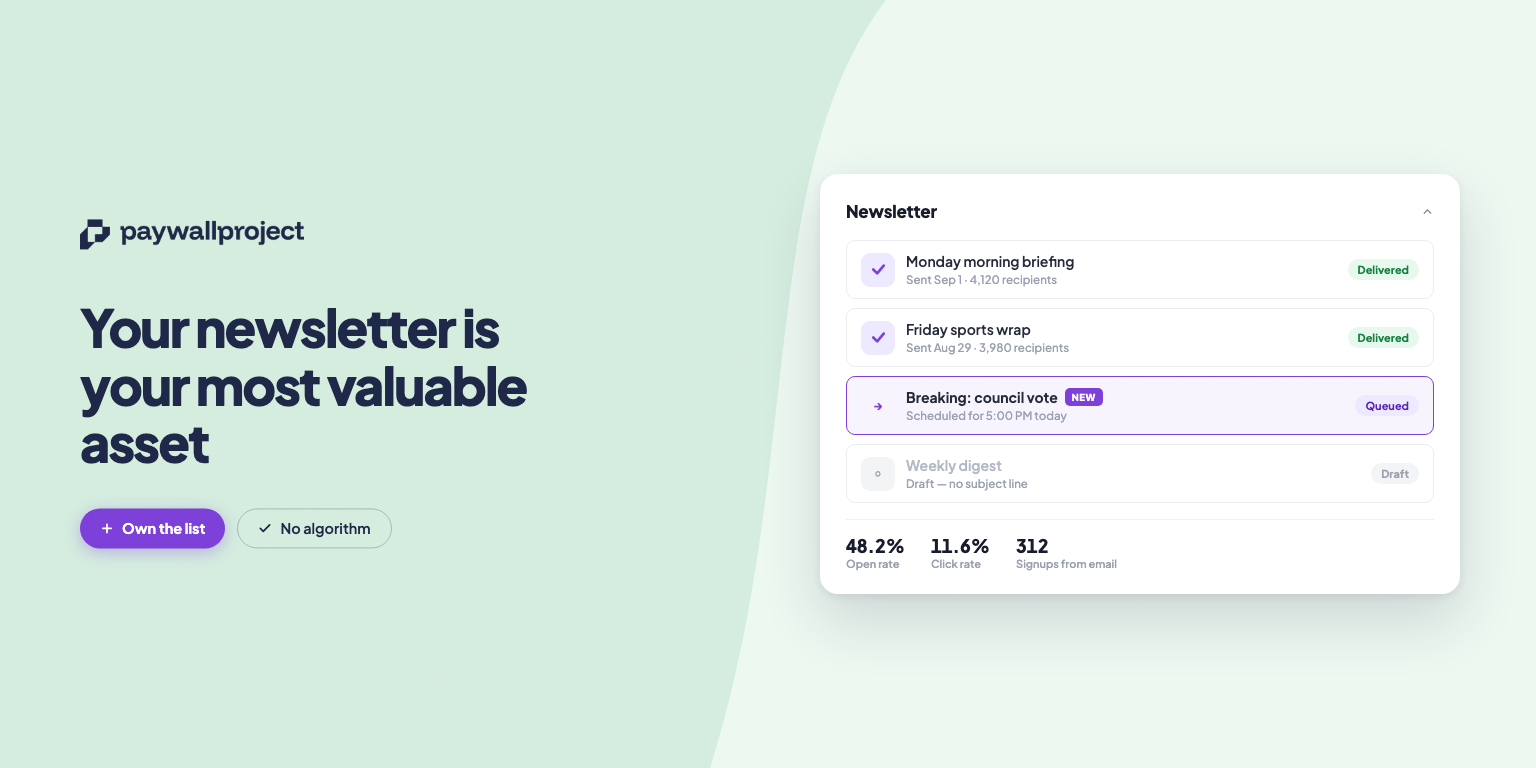
Your email list may be worth more than your paid subscriptions. Even if a subscriber never upgrades to a paid plan, their presence on your newsletter list creates real, monetizable value. Local businesses will pay premium rates to reach 20,000 engaged local readers directly. And unlike traffic from search or social, newsletter traffic is yours to control. We regularly see publishers generate thousands of pageview spikes the moment their newsletters hit inboxes.
Key Takeaways
- Every email address added to your list has a 10x higher chance of eventually converting to a paid subscription compared to anonymous visitors.
- Newsletter lists have standalone advertising value. Local businesses pay premium rates to reach engaged local audiences directly.
- Gating content with free registration (one free article, register for a second) grows email lists approximately 20% faster than traditional newsletter popups.
- Publishers control newsletter distribution entirely, eliminating dependence on unpredictable search and social algorithms.
- Content gating protects your journalism from AI scraping while still allowing search engines to index your work.
- Newsletter sends consistently generate thousands of pageview spikes, driving both ad impressions and subscription conversions.
- RSS-to-email automation lets news publishers send daily newsletters without manual assembly.
The Real Value of Your Email List
Most publishers think about email lists primarily as a path to paid subscriptions. That’s true. Data shows each email address has roughly 10x better odds of converting to a paying subscriber than an anonymous site visitor. But this framing misses half the opportunity.
Your email list has immediate value even if conversion rates were zero. Consider a local news publisher with 20,000 newsletter subscribers. Every local business wants access to that audience: restaurants, real estate agents, car dealerships, law firms. Unlike programmatic display ads that pay pennies and annoy readers, newsletter sponsorships command premium rates because they reach engaged, local readers who chose to receive your content.
Network ad revenue has collapsed for many publishers, dropping from thousands monthly to hundreds. Newsletter sponsorships move in the opposite direction. A targeted placement in front of 20,000 local readers is worth far more than random impressions from drive-by traffic.
Control Your Own Traffic
Search and social algorithms change constantly. A Google update can slash organic traffic overnight. Facebook’s reach for publishers has declined for years. AI overviews now answer queries without sending clicks to your site. Building your business on platforms you don’t control is building on sand.
Email is different. When you send a newsletter, it lands in inboxes. No algorithm decides whether subscribers see it. No platform takes a cut or throttles your reach. You control the timing, the content, and the relationship.
We regularly see publishers generate thousands of pageviews within hours of sending newsletters. That traffic spike is predictable and repeatable. It doesn’t depend on trending topics or algorithmic favor. It happens because you pressed send.
Protection Against AI Scraping
AI companies are training their models on publisher content without compensation. Your journalism feeds their products while you receive nothing in return. Content gating provides meaningful protection against this extraction.
When you require registration to access content beyond the first article, AI scrapers hit the same wall as any other visitor. They can see your headlines and first article, which maintains your visibility in search results, but your deeper archive stays protected behind the registration requirement. This approach lets Google index your content for discovery while preventing wholesale scraping of your journalism.
Publishers who gate nothing give everything away. Every article sits exposed for AI training datasets, content farms, and automated summarization tools. A registration wall creates friction that protects your investment in original reporting.
Growing Your List Through Content Gating
Traditional newsletter signups like popups, slide-ins, and footer forms convert poorly. Readers dismiss them reflexively. A better approach ties newsletter signup directly to content access through free registration.
The model works like this: give every visitor one free article without friction. On the second article, require free registration with email and password. That registration automatically adds them to your newsletter list. The reader gets continued access. You get a subscriber who demonstrated genuine interest by choosing a password.
Publishers using this approach see email acquisition rates increase approximately 20% compared to traditional methods. The psychology is simple. “Register to keep reading” converts better than “please join our newsletter.” One is a transaction with clear value. The other is a request.
PaywallProject includes this free registration layer built in. Set your meter to one free article, require registration for the second, and watch your list grow.
The Newsletter Flywheel
Your newsletter serves multiple functions simultaneously. It delivers value to readers, keeping them connected to your publication between visits. It drives traffic back to your site, generating ad impressions and exposing readers to subscription prompts. It builds a direct relationship that doesn’t depend on third-party platforms.
Each newsletter send restarts the cycle. Readers click through to articles, consume their free content, hit the registration wall or subscription prompt, and either convert or return when the next newsletter arrives. Over weeks and months, repeated exposure to subscription messaging increases conversion rates steadily.
This flywheel compounds. More subscribers mean more newsletter reach. More reach means more traffic. More traffic means more ad revenue and more subscription conversions. More conversions fund better journalism, which attracts more subscribers.
Newsletter Design That Works
For news publishers, keep newsletters scannable. Headlines, brief excerpts, links back to your site. Readers should be able to scan the entire email in under a minute and click what interests them. Images are optional. Many successful news newsletters use minimal imagery to maximize scan speed.
For magazine publishers, lean into visual presentation. Beautiful images are part of your brand. Feature two or three archive articles with compelling photography, generous excerpts, and clear calls to action.
Both approaches should include subscription promotion for free subscribers. Place a slim banner near the top and detailed benefits at the bottom where engaged readers land. Sponsor placements fit naturally at the bottom as well.
Subject lines matter enormously for daily newsletters. Lead with your brand, then highlight specific topics: “Grantham Star: School board meeting and soccer finals.” This tells readers who sent it and why they should open it.
Automate Where Possible
News publishers benefit most from RSS-to-email automation. Services like Mailchimp scan your site for new articles and assemble newsletters automatically based on your template. Schedule sends for 7 AM daily and your newsletter goes out without manual intervention.
Magazine publishers with less frequent publishing schedules often prefer manual assembly to maintain precise control over imagery and presentation. Either approach works. The key is consistent sending, not the method.
Start Building Today
If you’re not gating content with free registration, you’re leaving email addresses on the table. You’re also leaving your content exposed to AI scraping with nothing to show for it. If you’re not sending newsletters frequently, your list sits dormant while its value decays. If you’re not selling sponsorships, you’re ignoring revenue that doesn’t require readers to pay anything.
Your email list is an asset that grows more valuable over time. PaywallProject gives you the tools to build it: free registration, automated newsletters, and subscription prompts that convert. The sooner you start, the larger your list becomes, and the more options you have for monetizing your audience while protecting your content from extraction.