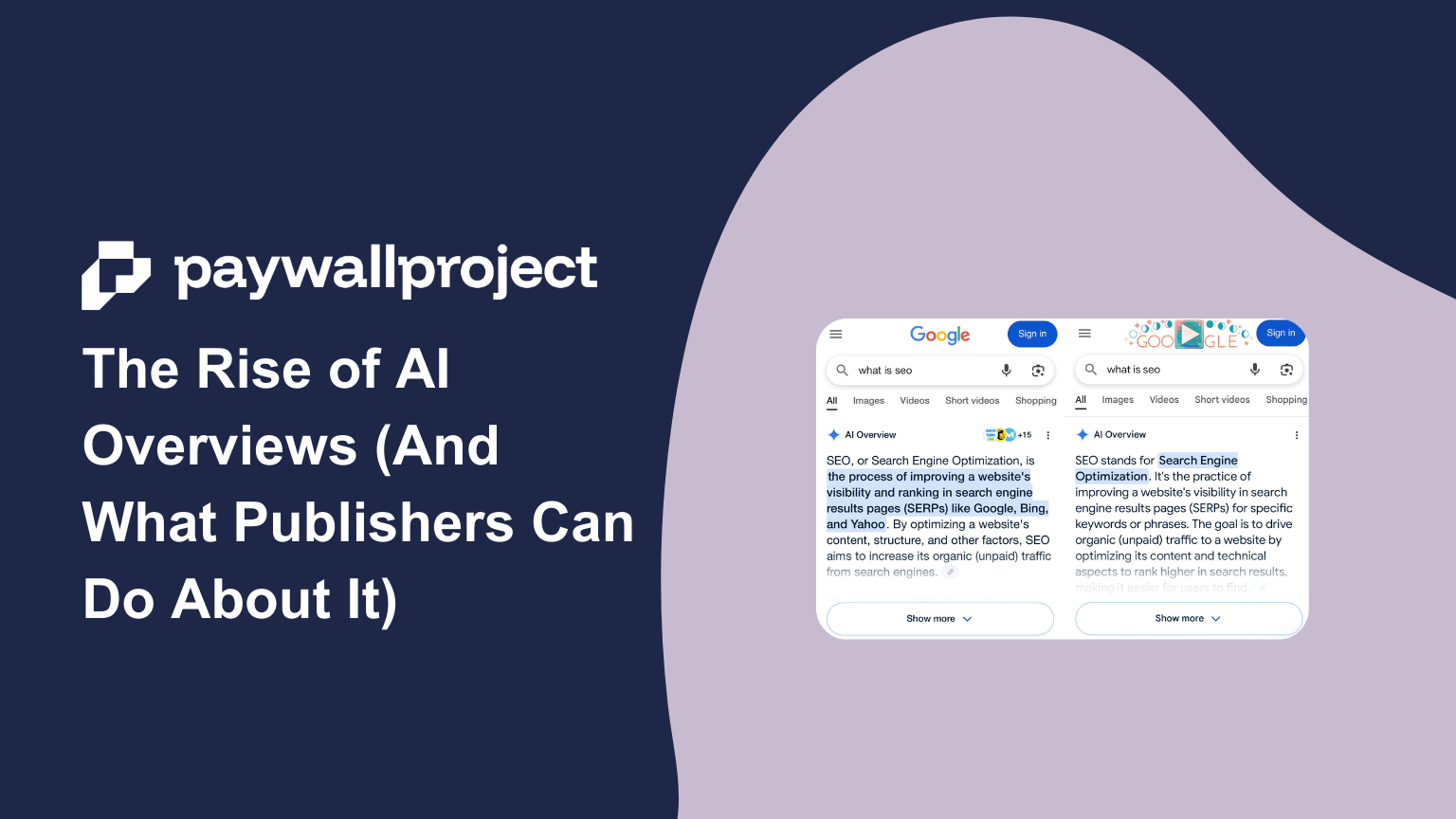
Google just had a record quarter. Search revenue crossed $400 billion for the first time ever. The company is calling it an “expansionary moment” driven by AI Overviews.
For publishers, it’s the opposite. It’s a contracting moment. And the data backs that up.
The Numbers Are Ugly
If you haven’t been tracking your organic search traffic lately, now is the time to start.
Google traffic to publisher websites has dropped roughly 30-38% in the US, according to Chartbeat. Click-through rates on search queries have fallen 61%. Users in AI mode spend three times longer on Google, getting what they need without ever visiting your site. Zero-click searches are now a standard part of the experience.
Google gets the ad revenue from keeping users on their platform longer. You get nothing.
Why Niche Publishers Aren’t Safe Either
There’s a common belief that niche and local publishers are insulated from AI Overviews. The thinking is that their content is too specific for AI to replicate well. For now, that’s partially true.
But AI is getting more powerful faster than most people expect, and it’s already coming for highly specific content.
Take a niche fishing publisher that covers the Northeast coast. They have real-time fishing reports, live data from captains on the water, hyper-local conditions updated daily. That’s about as niche and timely as it gets.
Yet when you search “where is the best fishing today off of Long Island,” Google’s AI Overview serves up a detailed answer with locations, species, and access points. This publisher might get a citation buried somewhere in the expanded results. But buried in an AI Overview is basically the same as being on page 15 of Google. Nobody’s clicking.
The window of protection for niche publishers is real, but it’s finite. Don’t wait until your traffic drops to start building your defenses.
Licensing Deals Won’t Save You
Some AI companies are offering licensing deals to publishers in exchange for using their content. The math doesn’t work.
Publishers will see no meaningful revenue from AI licensing. The Nieman Lab has said as much directly.
Beyond the tiny payout, licensing your content to AI companies means giving up the thing that actually matters: your relationship with your audience. When someone reads your content through an AI interface, they’re not on your site. They’re not on your email list. They’re not seeing your subscription offer or attending your events. The cascading effect of losing audience ownership is worse than the licensing revenue could ever offset.
The New Metric Trap
The industry is starting to push something called “share of answer.” The idea is that publishers should optimize to appear in AI Overview citations. Some are calling it a new KPI stack: citation visibility, brand recall, share of answer.
Don’t fall for it.
Chasing share of answer is a distraction. It’s optimizing for someone else’s platform with no guarantee of return. Your real superpowers are your content and your audience. That’s where your energy should go.
What Actually Works: Registration Walls and Email
The only durable defense against AI eating your traffic is owning your audience directly. That means email.
Instead of a generic “join our newsletter” popup, which converts at around 3-5%, put a free registration wall in front of your content. Require an email address to access articles beyond the first. Conversion rates jump to around 20%.
That email address goes into your ESP. Now you own that reader. You can send them back to your site whenever you publish. You’re not dependent on whether Google’s algorithm or AI Overview decides to surface your content that day.
A few important benefits stack on top of this:
Audience control. Your newsletter sends readers directly back to your site. You control the distribution, not Google.
AI protection. A registration wall prevents AI bots from scraping your full article content. If a bot hits a registration gate, it gets a sentence or two at most, not the full piece you spent time creating.
Subscription conversion. When you tighten your walls and force readers to make a decision, paid subscriptions tend to go up alongside free registrations. You’re converting the casual reader into an engaged one.
Sponsor and ad value. A large, engaged email list is worth real money to sponsors. Traffic for its own sake is worth very little.
Predictability. Monthly and annual subscribers provide revenue you can count on. Google algorithm changes and AI model updates are not things you can plan around.
One fishing publisher tightened their registration wall in early 2025. Their free registrations tripled almost immediately. Paid subscriptions followed. That’s not a coincidence. It’s what happens when you stop giving your content away and start trading it for a relationship.
How to Think About the Soft vs. Hard Wall Decision
Most publishers today run some form of metered or “leaky” paywall. Maybe one free article per month, then a registration prompt. This approach lets Google index your content, lets social sharing work, and gives you some SEO benefit while still building your list.
That’s a reasonable place to be right now, but only if you’re using it intentionally as a stepping stone.
If your email list represents less than 10-20% of your target market, you probably still need the SEO and social sharing benefits of leaking some content. Run the registration wall on article two or three and build your list aggressively.
If your list is growing and paid subscriptions are moving, start considering a harder wall. Lock down your highest-value content and protect it from AI entirely.
One important thing to keep in mind: Google’s SEO bot and its AI bot are the same bot. You cannot tell Google to index your content for search but not scrape it for AI Overviews. When you lock down your site, you lose both. That’s the tradeoff, which is exactly why building your email list first gives you the confidence to eventually make that move.
Target Numbers to Aim For
For local news publishers, the leaders in their markets are hitting 5-10% of the local population as paid subscribers and 20% of the target market on the email newsletter.
Those are your benchmarks. If you’re running a niche publication, you’ll need to define your total addressable audience and work from there, but the ratios hold.
The Bottom Line
You have two superpowers as a publisher: your content and your audience. AI is coming for your content whether you like it or not.
The answer is to use your content as leverage to build your audience, and then own that audience completely.
Set up a free registration wall. Leak one article at most before the gate hits. Build your email list fast. As your list grows and subscriptions strengthen, get comfortable with the idea of locking AI out entirely.
The publishers who do this aren’t just surviving the AI moment. They’re building something more durable than any SEO strategy ever was.
Questions about implementing a registration wall or paywall for your publication? Get in touch with the PaywallProject team.