Subscriber churn is quiet. It doesn’t announce itself. One month a reader is engaged, and a few months later they’re gone, and most publishers never find out why.
Here’s a number worth sitting with. A publisher losing 10% of subscribers every month loses 70% of their subscriber base in a year. Even a modest 3% monthly churn rate wipes out a third of your subscribers annually.
The good news is that churn is fixable. And one of the most overlooked fixes is something every publisher already has access to: the email newsletter.
The Publisher Who Never Sent a Newsletter
We recently worked with a local news publisher that grew steadily for about six years. Compounding growth, low churn, a solid subscriber base.
Then things plateaued. Eventually they declined.
The cause wasn’t a single dramatic event. It was the absence of one basic habit. This publisher had never sent a newsletter. Not once, in six years.
No onboarding emails. No mission-driven updates. No regular touchpoint with their audience at all. The only time readers heard from the publication was when they happened to visit the website on their own.
That’s a tough position for any publisher. Traffic declined alongside subscriptions, because without a newsletter, there’s no reliable way to bring readers back.
Why Newsletter Engagement Predicts Retention
Newsletter engagement is one of the strongest predictors of whether a subscriber sticks around. Subscribers who open newsletters regularly are roughly twice as likely to still be subscribed a year later.
Research tracking newsletter onboarding across thousands of new subscribers found the same pattern. Early onboarding emails improved both engagement and subscription duration.
Publishers who send newsletters three or more times a week see the strongest retention results. For local news publishers already producing daily content, this is a low-lift, high-return move. You’re already writing the stories. The newsletter just needs to go out.
Building a Newsletter Habit Readers Notice
Think of your newsletter as a routine, not a one-off announcement. Readers build habits around consistent delivery. When a local newsletter shifted its send time from 6 a.m. to 9 a.m., readers noticed immediately, because it no longer matched their morning routine.
For local news publishers, consistency matters more than length. A single well-chosen article in a newsletter often performs better than a long roundup, because most readers won’t scroll through everything anyway. Readers appreciate hearing from you at all. You don’t need ten stories to justify hitting send.
Personalization and Regional Content
Publishers with regional coverage can boost engagement further by letting readers opt into specific categories or regions. Localized, opted-in content consistently drives the highest engagement rates, because readers get exactly the coverage that matters to their community.
Local publishers often worry they don’t have enough content for this kind of segmentation. In practice, even one or two relevant stories per region is enough. Readers aren’t looking for volume. They’re looking for relevance.
Watching for Subscribers Who Go Quiet
Retention isn’t only about sending newsletters. It’s also about watching subscriber behavior and catching disengagement before it turns into cancellation.
Tracking which paid subscribers have stopped opening content or visiting your site gives you an early warning sign. A re-engagement campaign, whether a drip series of evergreen content or a simple check-in email, can pull subscribers back before they churn silently.
Most readers have only seen a small fraction of everything you’ve published. Evergreen archive content is often more valuable for re-engagement than brand-new stories, since it’s genuinely new to most of your audience.
Fixing Involuntary Churn
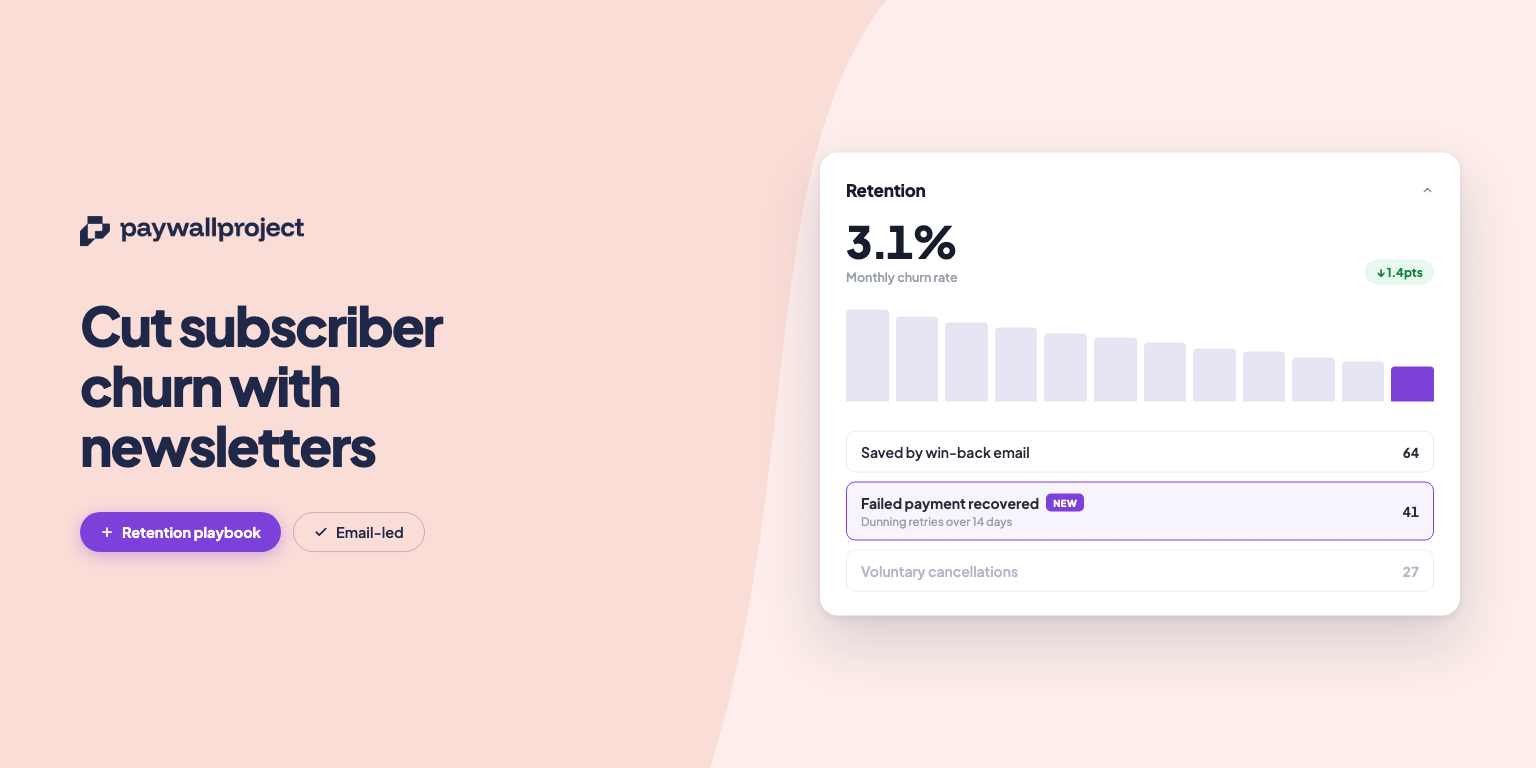
Not all churn is a choice. Somewhere between 20% and 40% of subscriber churn happens involuntarily, from failed payments, expired cards, and declined charges.
This is where payment infrastructure matters. Platforms that actively retry failed payments and manage dunning emails can recover a meaningful share of subscriptions that would otherwise be lost to a simple expired card. Publishers who move to stronger payment processing have seen churn related to failed payments drop significantly.
Pairing strong payment retry logic with a dunning email sequence (a short series of reminders asking subscribers to update their card) is one of the easiest wins available. It requires no content strategy, just infrastructure.
Reducing Login Friction
Login friction is an underrated churn driver. Subscribers who can’t easily log in to read the content they’re paying for get frustrated, and frustration leads to cancellations.
Automatic login from newsletter links removes this barrier entirely. When a subscriber clicks an article link from their newsletter, they should land on the site already logged in, with zero extra steps. Publishers who implement this see login-related support tickets drop dramatically.
This matters just as much for free registered readers as it does for paid subscribers. Free readers who hit a login wall when clicking a newsletter link are unlikely to bother logging in, and every one of those moments is a missed chance to show upgrade messaging and move them toward a paid plan.
Making Cancellation a Conversation, Not a Dead End
When a subscriber does try to cancel, that moment shouldn’t be the end of the relationship. Offering a discount, a pause option, or a downgraded plan at the point of cancellation gives subscribers a reason to stay instead of leaving entirely.
Even when a subscriber does cancel, a short exit survey can surface valuable feedback. Login trouble, pricing concerns, or content gaps often show up in these responses, giving publishers a clear signal for what to fix next.
Pricing Choices That Support Retention
Annual plans tend to reduce churn more effectively than monthly plans, since a single yearly renewal creates far less friction than twelve separate monthly charges. Many local news publishers find their subscriber base leans toward annual plans already, often by a notable margin.
Offering monthly subscribers a discounted path to an annual plan is a simple way to convert short-term subscribers into longer-term, lower-churn ones.
Tiered pricing, even when not heavily promoted, gives publishers a fallback option for subscribers considering cancellation. A slightly lower-priced tier with fewer perks can retain a subscriber who might otherwise cancel entirely.
The Bottom Line for Local Publishers
Newsletter frequency solves more problems than churn alone. It supports traffic growth, builds reader habits, and keeps your publication visible in an increasingly crowded inbox.
The publishers who struggle most with retention are often the ones who treat the newsletter as optional or occasional. Automating newsletter delivery around your existing content publishing schedule removes the workload concern entirely. You publish. The newsletter goes out. No extra production burden required.
For local and regional newspapers specifically, this is one of the highest-leverage, lowest-cost retention strategies available. A consistent newsletter, paired with smart payment retry logic and frictionless login, addresses the majority of avoidable churn before it happens.